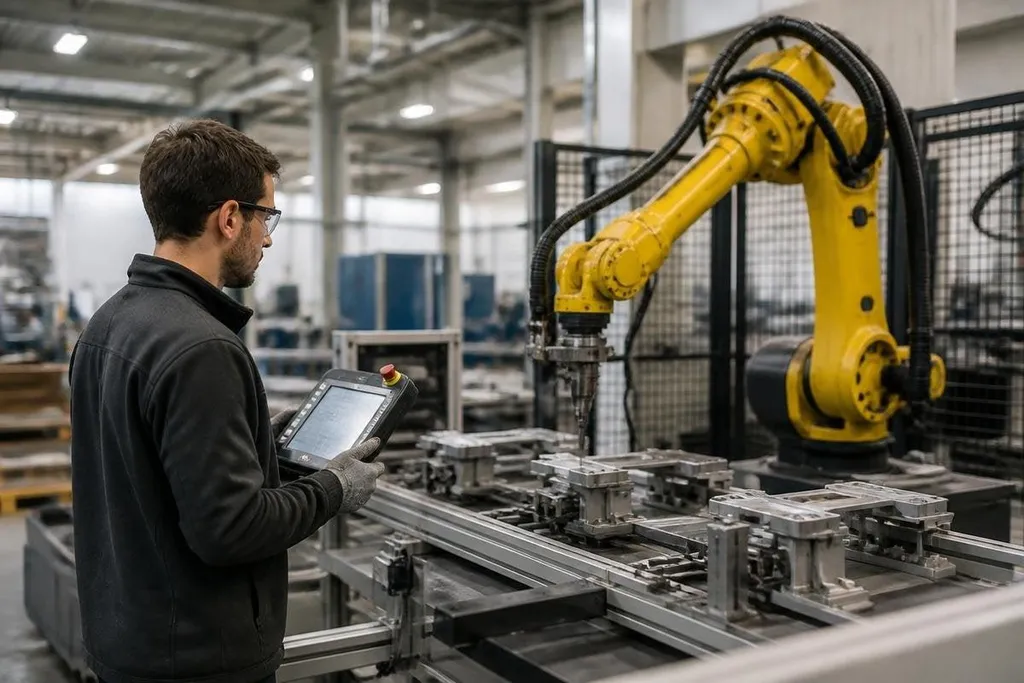
A factory robot can repeat the same movement for hours while a worker handles setup, checks, repairs, and decisions. That division matters as manufacturers try to make more products with fewer delays and less exposure to dangerous work.
For a plant manager, the question is practical: which task should a robot take over, and what work stays with people?
Quick read
- Robots repeat fixed tasks with steady speed and position.
- Sensors and cameras let newer systems react to changes in parts and placement.
- The purchase price is only one part of the decision; integration and service also affect the result.
Robots fit work with a clear pattern
Industrial robots work best when a task has a known start point, a known end point, and enough repeat cycles to justify setup. A six-axis arm can move a tool or gripper through several angles, so one system may handle welding, machine tending, or part loading after the plant has set its motion path.
That repeatability changes the job around the robot. A worker may load raw parts into a fixture, check the finished weld, or respond when a sensor detects a fault. The robot handles the repeated motion, while people deal with changes that the program does not expect.
The same rule applies to palletizing. The robot can place boxes in a set pattern, but the system still needs information about box size, stack height, conveyor position, and safe access around the cell. A small change in packaging can require a new program or a new gripper.
Sensors make the cell less rigid
Older robot cells often depend on fixtures that hold each part in one exact position. Cameras, force sensors, and light detection help a robot find a part or check contact, which reduces the need for perfect placement before every cycle.
That does not turn the cell into an all-purpose worker. A camera may find the part but fail to tell a soft plastic item from a damaged one. Force feedback may detect contact, yet the robot still needs rules for what to do next. The quality of the sensor data and the software behind it decide how much change the system can handle.
Sensor limits become a design issue once a factory robot works beside people. Robot24.com’s factory robotics coverage can connect those control choices to named machines, test sites, and dates. That record leads into the next question: how safety rules change the cell.
Safety changes the design
An arm can move a heavy tool at high speed, so its work area needs a safety plan before production starts. Guards, light curtains, emergency stops, speed limits, and safe restart rules are part of the cell, not items to add after installation.
Collaborative robots use force limits and other controls to work near people in specific conditions. That label does not remove the need for a risk check. The tool, payload, speed, sharp edges, and motion path still affect the hazard.
ISO 10218 sets safety requirements for industrial robots and robot systems. A plant also needs training, inspection records, and a clear response when the cell stops. A robot that waits for a technician after every small fault will not help much, even if its arm works as planned.
The cost sits outside the arm
The robot itself is only one purchase.
The cell may also need a gripper, controller, camera, guarding, conveyor changes, software work, worker training, and service parts. Those items can decide whether a project fits the plant’s budget.
Production volume matters too. A task that repeats through every shift gives the plant more chances to recover the setup cost. A task that changes each hour may need better sensing or human work instead.
I think factory robots matter most when a company treats them as part of a work cell, not as a replacement for a full job. That view leads to a better question: what repeated motion slows the line, and what support will the people around it need?
A practical buying check
Use this list before choosing a robot for a production task:
- Map the task: record the part weight, reach, cycle steps, and changeovers.
- Check the surroundings: mark people, doors, conveyors, tools, and access points.
- Price the full cell: include the arm, gripper, sensors, guarding, software, training, and service.
- Test failure cases: see what happens when a part is missing, turned around, damaged, or out of position.
- Set a human handoff: name who responds to stops and who approves a restart.
- Measure the result: track cycle time, downtime, defects, and maintenance work after installation.
A good project starts with a repeated task and a clear measure of success. The next factory robots will matter when they can handle more variation without making the cell harder to supervise, and that depends on better sensing, safer control, and software that workers can fix when the normal cycle breaks.